Electrician in Bedford: Safe, Smart Power for Homes, Workplaces and Future Energy
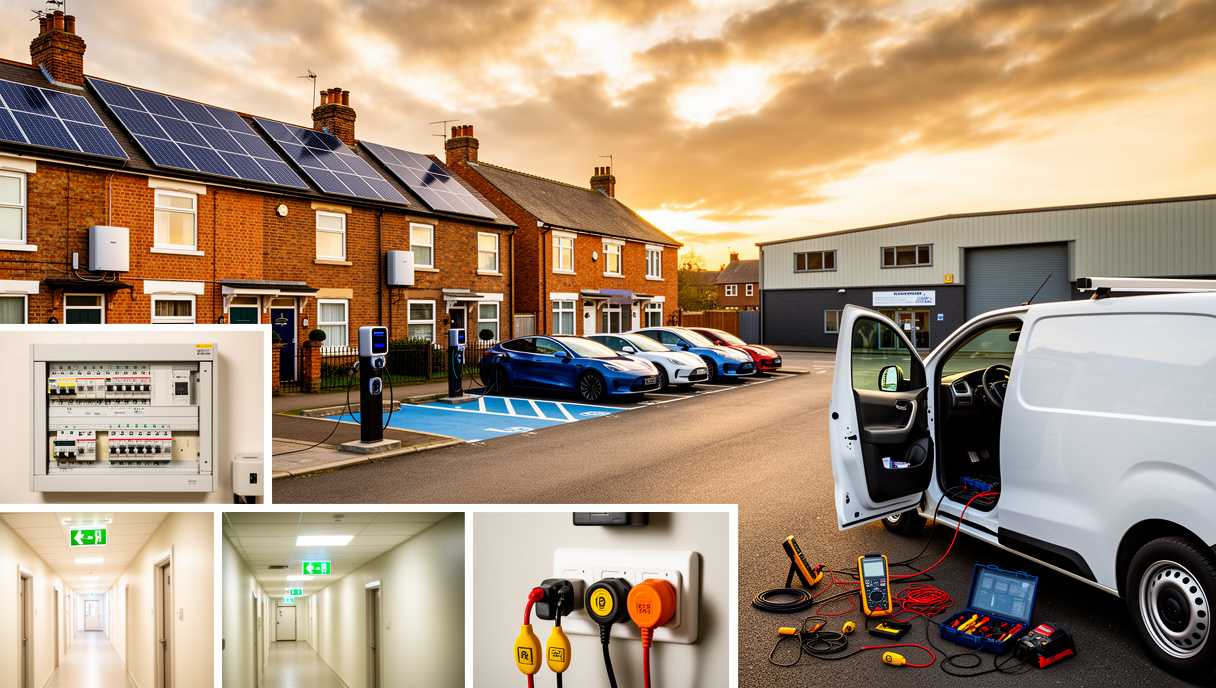
From riverside terraces to new-build estates and busy business parks, Bedford’s mix of properties all share one need: dependable, compliant and efficient electrics. A local expert helps you protect people, keep equipment running and control energy costs, whether you’re upgrading a consumer unit, commissioning an EICR, installing EV chargers or adding solar panels and battery storage. With modern installations guided by BS 7671 and Building Regulations, and maintenance that prevents downtime, choosing the right partner ensures your electrics remain safe today and resilient for tomorrow.
Why choosing a local electrician in Bedford matters
Electrical work touches every part of daily life: lighting, heating, IT, machinery, security and more. When issues arise, local knowledge delivers faster, safer outcomes. Bedford’s housing stock includes Victorian and Edwardian terraces with aged wiring alongside post-war semis, 1990s estates in Brickhill and Putnoe, and newer developments in Wixams, Great Denham and Biddenham. Each brings different cable routes, insulation types and earthing arrangements that influence how a fault is diagnosed or a consumer unit upgrade is specified. Commercially, units in Elstow and Kempston, schools in De Parys and retailers in the town centre require robust compliance and minimal disruption to operations.
When you’re comparing providers, choosing an Electrician in Bedford with hands-on experience of local building methods, grid constraints and typical usage patterns means problems get solved at the root, not just patched. A skilled contractor helps you navigate BS 7671 requirements for RCD protection, surge protection device selection and bonding, and ensures Building Regulations Part P notifications are handled for notifiable domestic work. For businesses, familiarity with on-site permit processes, risk assessments and isolation procedures keeps projects safe and on schedule.
Compliance is especially important for landlords and duty-holders. Regular EICR reports verify that wiring, protective devices and accessories are still serviceable, while PAT testing checks portable appliances for damage or faults. In communal areas and commercial premises, emergency lighting must be tested and logged, and signage illuminated to guide safe evacuation. A proactive Bedford-based team helps you anticipate these tasks, coordinate access and avoid last-minute scrambles ahead of audits or tenant move-ins.
Local responsiveness also matters when time is critical. A tripping RCD on a damp day, a failing immersion circuit on a winter evening, or a dead socket ring feeding a card terminal can stop a household or a shop in its tracks. An experienced Bedford electrician who understands common fault patterns in the area—rodent damage in lofts, DIY junction boxes under floors, corroded garden circuits, overheated MCBs in legacy boards—can fault-find efficiently, replace unsafe components and document the fix, restoring confidence as well as power.
Services that protect, power and save—at home and at work
Reliable domestic electrics start with a safe backbone. That often means upgrading an outdated fuse box to a modern, metal, fire-rated consumer unit with RCD/RCBO protection, appropriate surge protection and clear circuit labelling. From there, a periodic EICR reveals wear-and-tear—brittle insulation, loose terminations, mismatched breakers—that might not be obvious until something goes wrong. Rewiring, whether partial or full, replaces ageing cable runs and eliminates ad-hoc spurs; meanwhile, dedicated circuits for ovens, showers, heat pumps or EV chargers keep loads balanced and within manufacturer requirements. For comfort and efficiency, LED lighting upgrades slash consumption and improve brightness, while smart controls allow zoned, timed and dimmable scenes that fit your routine.
Commercial and industrial sites demand robust and well-documented installations. Three-phase distribution, machinery supplies and high-bay LED lighting must be sized for continuous duty and verified under load. Emergency lighting design ensures compliant escape routes; PAT testing and user checks reduce appliance risks; and scheduled maintenance prevents small issues becoming costly stoppages. In offices, schools and retail spaces, clean, glare-free illumination improves wellbeing and reduces energy bills. In warehouses and factories, sensor-based LED retrofits with occupancy and daylight harvesting can unlock major savings while improving safety with better colour rendering and coverage.
Renewable and low-carbon systems are increasingly central to Bedford’s energy strategy. Professionally designed solar panels with battery storage can capture daytime generation and shift it into the evening peak, cutting import costs and adding resilience during utility outages. Smart EV charge points with load management avoid overloading incoming supplies by dynamically sharing available capacity across devices. An integrated approach—coordinating PV, storage and chargers—keeps the system compliant with grid rules and ensures your consumer unit, earthing and protection are correctly specified for combined technologies.
Real-world examples highlight the benefits. In a Kempston semi, a homeowner combining a consumer unit upgrade with LED lighting and targeted rewiring eliminated nuisance trips and saw noticeably brighter, flicker-free rooms at a fraction of the previous energy use. On a Bedford industrial estate, replacing ageing sodium high-bays with LED luminaires and adding smart controls reduced lighting energy by more than half, improved picking accuracy and lowered maintenance callouts. Across both scenarios, meticulous testing—insulation resistance, continuity, loop impedance and RCD trip times—proved the improvements were not just visible, but verifiably safe and compliant.
From design to documentation: how a professional job gets done
Quality begins long before the first cable is pulled. A thorough survey documents existing circuits, protective devices, bonding, containment routes and spare capacity. Load profiles are assessed to plan for peaks and diversity, while coordination with the DNO may be needed if capacity upgrades or export-limiting (for solar panels) are under consideration. The design stage selects cable sizes, protective device types, RCD/RCBO configurations and surge protection according to BS 7671, and outlines containment that suits the environment—surface trunking in workshops, discreet routes for period properties, or fire-rated supports in escape routes.
During installation, safe isolation and clear sequencing minimise downtime. Good workmanship shows in neat terminations, correct torqueing, labelled distribution ways and appropriately rated accessories. Outdoor circuits receive the right IP ratings, RCD protection and mechanical protection; bathrooms respect zoning rules; kitchens use dedicated cooker, hob and appliance circuits; and garages or outbuildings get properly sized submains. For low-carbon upgrades, EV chargers are sited for cable reach, accessibility and Wi‑Fi signal, and battery storage locations account for ventilation and fire safety guidance.
Verification is non-negotiable. Testing covers continuity of protective conductors, insulation resistance, polarity, earth fault loop impedance (Zs), RCD trip times, and functional checks of controls and safety devices. Results feed into the Electrical Installation Certificate (EIC) or Minor Works Certificate (MEIWC), complete with circuit schedules and protective device details. For existing premises, an EICR documents observations and coding, helping owners prioritise remedial work by risk. Emergency lighting systems are function-tested and duration-tested, with logbooks updated for auditors and insurers. Where surge protection is fitted, labelling notes replacement indicators so maintenance teams know when to intervene.
After handover, planned maintenance keeps systems dependable and efficient. RCD testing at recommended intervals confirms life-safety devices will operate when needed; PAT testing schedules reflect appliance risk and usage; thermal imaging can identify hot spots in distribution boards before a failure occurs; and lighting controls are fine-tuned to match occupancy and daylight. For renewables, monitoring portals reveal generation, consumption and state-of-charge, enabling tweaks that boost self-consumption and cut bills. As standards evolve—such as amendments to the 18th Edition—your maintenance plan adapts, ensuring your installation remains compliant, insurable and ready for future expansion.

Windhoek social entrepreneur nomadding through Seoul. Clara unpacks micro-financing apps, K-beauty supply chains, and Namibian desert mythology. Evenings find her practicing taekwondo forms and live-streaming desert-rock playlists to friends back home.


Post Comment